
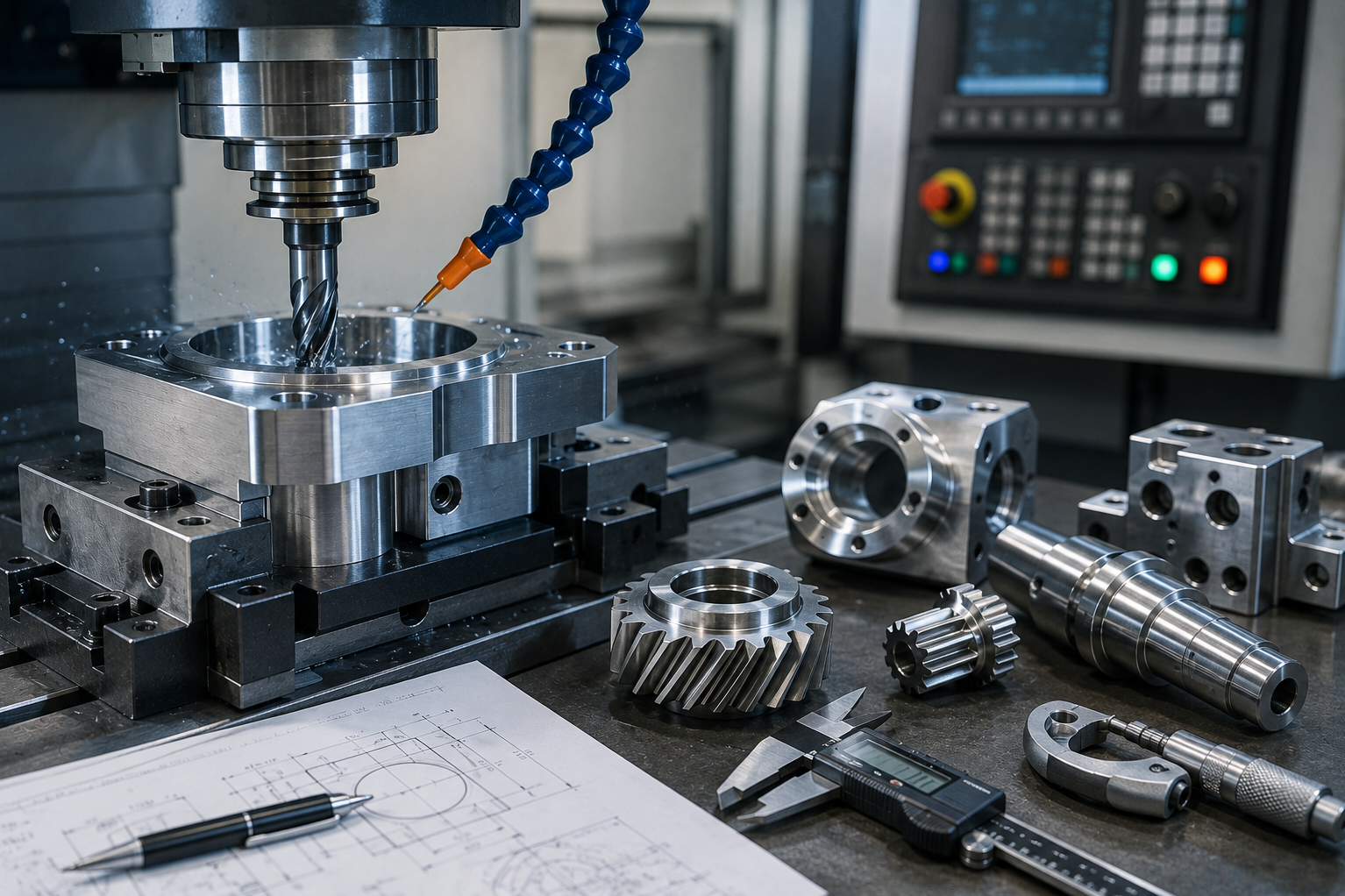
Precision machining has become one of the most important manufacturing processes for industries where accuracy, consistency, and repeatability directly influence product performance. Whether producing automotive components, defence equipment, pharmaceutical machinery, or mining parts, even a small dimensional deviation can affect assembly, operational efficiency, and product lifespan.
As manufacturing technologies continue to evolve, precision machining enables industries to produce complex components with tighter tolerances and superior surface finishes while maintaining consistent quality across large production volumes.
What Precision Machining Means
Precision machining is the process of removing material from a workpiece using computer-controlled machines to achieve exact dimensions, shapes, and surface finishes.
Unlike conventional machining, precision machining focuses on producing components that meet strict engineering drawings with minimal variation between batches.
The process commonly includes:
- CNC turning
- CNC milling
- Drilling
- Boring
- Threading
- Surface finishing
Every operation is carefully programmed to ensure repeatable accuracy, making it suitable for industries that cannot compromise on component quality.
Why Accuracy Matters in Industrial Components
Modern machinery consists of multiple interconnected parts. If one component falls outside the required tolerance, it may create problems throughout the assembly.
Poor machining accuracy can lead to:
- Improper component fit
- Increased vibration
- Premature wear
- Reduced machine efficiency
- Frequent maintenance
- Higher production downtime
Precision machining helps eliminate these issues by ensuring every manufactured component matches the intended specifications.
Industries That Depend on Precision Machining
Many manufacturing sectors rely on accurately machined components for daily operations.
Automotive Manufacturing
Automotive manufacturers require precision-machined parts for engines, transmissions, suspension systems, fixtures, and production equipment. Consistency is essential because thousands of identical components may be produced every day.
Earthmoving Equipment
Heavy-duty construction machinery operates under high loads and continuous stress. Precision-machined shafts, housings, brackets, and hydraulic components help maintain equipment reliability in demanding environments.
Defence Equipment
Defence manufacturing demands exceptionally high accuracy. Components often require close tolerances to ensure reliable performance under challenging operating conditions while complying with strict engineering standards.
Mining Machinery
Mining equipment works in abrasive environments where precisely machined wear-resistant components contribute to longer service life and reduced maintenance interruptions.
Pharmaceutical Machinery
Equipment used in pharmaceutical manufacturing relies on accurately machined components to maintain smooth machine movement, process stability, and dependable production performance.
Materials Suitable for Precision Machining
Different industrial applications require different materials based on strength, hardness, corrosion resistance, and operating conditions.
Frequently machined materials include:
- Mild steel
- Carbon steel
- Alloy steel
- Stainless steel
- Tool steel
- Cast iron
- Aluminium alloys
Selecting the appropriate material is just as important as the machining process itself, as it influences durability and long-term performance.
Modern CNC Technology Enhances Precision
Today's precision machining largely depends on advanced CNC technology.
Computer-controlled machines offer several advantages:
- High repeatability
- Reduced manual errors
- Faster production cycles
- Better dimensional consistency
- Improved surface finishes
- Efficient handling of complex geometries
Automation also enables manufacturers to produce both prototypes and high-volume production batches with dependable quality.
Quality Control Throughout the Machining Process
Precision machining extends beyond operating sophisticated machines. Inspection and verification play an equally important role.
Manufacturers typically perform quality checks during multiple stages, including:
- Raw material inspection
- In-process dimensional measurement
- Tool wear monitoring
- Final inspection
- Surface finish evaluation
- Documentation of critical dimensions
Regular inspection helps identify deviations before they affect subsequent production stages, reducing waste and improving manufacturing efficiency.
Benefits of Working With an Integrated Manufacturing Partner
Many industrial projects require fabrication, machining, welding, and assembly before a component is ready for installation.
Choosing a manufacturer capable of handling multiple processes under one facility can offer several operational advantages:
- Better production coordination
- Improved dimensional control
- Reduced transportation between vendors
- Faster project completion
- Simplified quality management
Industrial manufacturing clusters such as Chakan have become preferred locations for OEMs because they provide access to advanced machining infrastructure, experienced engineering teams, and an established supplier network that supports efficient production.
Pranav Heavy Industries Private Limited combines precision machining with fabrication and heavy engineering capabilities to manufacture components for industries including automotive, earthmoving equipment, defence, mining, and pharmaceutical machinery. By integrating advanced machining processes with rigorous quality control, the company supports OEMs seeking reliable, accurately manufactured engineering components that meet demanding industrial applications.