

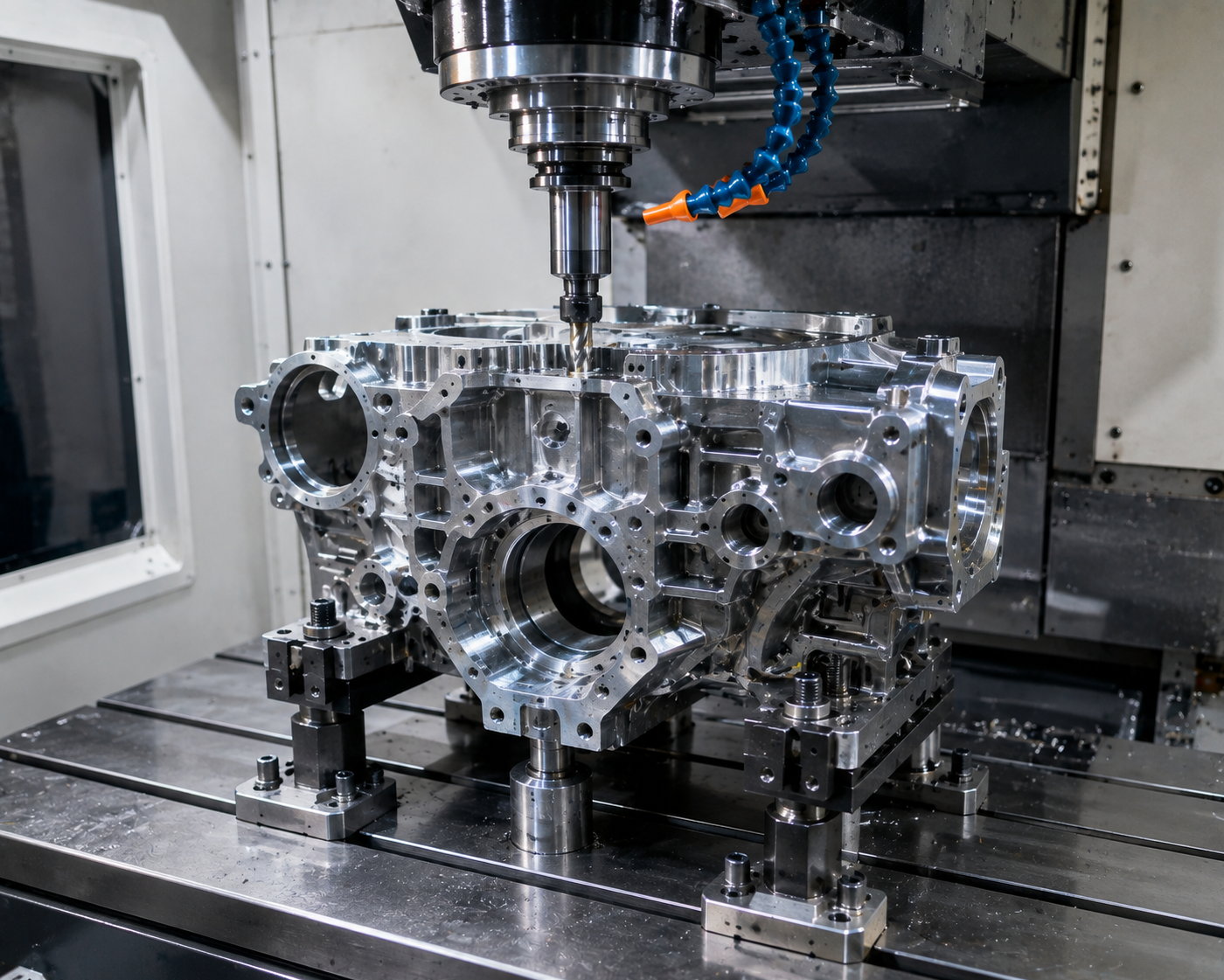
Horizontal Machining Centre (HMC) machining has become an essential manufacturing solution for producing large, complex, and high-precision engineering components. Industries such as automotive, mining, defence, earthmoving equipment, and pharmaceutical machinery increasingly depend on HMC machining to achieve consistent quality while improving production efficiency.
Unlike conventional machining methods, HMC machines are designed to perform multiple operations on different faces of a component with minimal manual intervention. This capability reduces production time, improves dimensional accuracy, and supports high-volume manufacturing where consistency is critical.
Understanding HMC Machining
A Horizontal Machining Centre features a spindle positioned horizontally, allowing the cutting tool to approach the workpiece from the side. This arrangement enables chips to fall away naturally during machining, reducing heat buildup and improving cutting efficiency.
HMC machining is widely used for manufacturing complex components that require machining on multiple surfaces without repeated repositioning.
Typical machining operations include:
- Precision milling
- Boring
- Drilling
- Thread tapping
- Contour machining
- Pocket milling
- Multi-face machining
The ability to complete several operations within a single setup makes HMC machining particularly suitable for heavy engineering applications.
Why HMC Machining Is Preferred for Complex Components
Industrial manufacturers often deal with components that have intricate geometries, multiple machining faces, and demanding dimensional requirements. HMC machining offers several advantages that help address these challenges.
Key benefits include:
- Improved machining accuracy
- Faster production cycles
- Better surface finish
- Reduced manual handling
- Enhanced repeatability
- Lower setup time
- Greater productivity for batch manufacturing
These advantages make HMC machining an efficient choice for OEMs seeking dependable quality and shorter manufacturing lead times.
Industries That Benefit From HMC Machining
Many heavy engineering sectors rely on HMC machining to produce precision components capable of performing under demanding operating conditions.
Automotive Manufacturing
Automotive production requires accurately machined engine housings, transmission casings, fixture plates, suspension components, and gearbox parts. HMC machining supports large production volumes while maintaining uniform quality across every batch.
Earthmoving Equipment
Construction and infrastructure machinery contain heavy components that demand exceptional dimensional accuracy. HMC machining is commonly used for structural housings, hydraulic blocks, mounting bases, and transmission components.
Mining Equipment
Mining machinery operates in abrasive environments where robust engineering is essential. Precision-machined components help minimise wear, improve equipment reliability, and reduce maintenance downtime.
Defence Equipment
Defence applications require high-quality engineering components manufactured according to strict dimensional specifications. HMC machining enables the production of complex parts with dependable repeatability and precision.
Pharmaceutical Machinery
Industrial machinery used in pharmaceutical manufacturing depends on precisely machined structural and functional components that contribute to stable machine operation and consistent production performance.
Materials Suitable for HMC Machining
Horizontal machining centres can process a broad range of engineering materials depending on customer requirements and end-use applications.
Common materials include:
- Mild steel
- Carbon steel
- Alloy steel
- Stainless steel
- Cast iron
- Aluminium alloys
- High-strength engineering steels
The correct machining strategy is selected based on material properties, component complexity, and required surface finish.
Factors That Influence Machining Quality
Achieving consistently accurate results involves more than advanced machinery. Several production factors contribute to overall machining performance.
Manufacturers closely monitor:
- Machine calibration
- Cutting tool condition
- Fixture accuracy
- Programming precision
- Material consistency
- Coolant management
- In-process inspection
Controlling these variables helps maintain dimensional accuracy while improving overall production efficiency.
Quality Assurance Throughout Manufacturing
Reliable HMC machining includes inspection at multiple stages rather than only at the end of production.
Typical quality practices include:
- Raw material verification
- First-off inspection
- In-process dimensional measurement
- Surface finish evaluation
- Final inspection before dispatch
These checks help ensure every component conforms to engineering drawings and customer specifications while reducing the possibility of costly rework.
Choosing an Integrated Manufacturing Partner
Many industrial projects involve fabrication, machining, welding, and final assembly before components are ready for installation. Working with a manufacturer that offers these capabilities under one roof can simplify production planning and improve coordination.
Manufacturing hubs such as Chakan have become important destinations for OEMs because they offer access to advanced CNC infrastructure, skilled engineering professionals, and a well-developed industrial ecosystem. This supports efficient production for customers across Maharashtra and other major manufacturing regions.
Pranav Heavy Industries Private Limited provides HMC machining alongside heavy fabrication, precision machining, and engineering assembly services. By integrating advanced machining technology with comprehensive quality control, the company supports industries including automotive, earthmoving equipment, mining, defence, and pharmaceutical machinery with precision-engineered components designed to meet demanding industrial applications.